Rejuran vs Juvelook

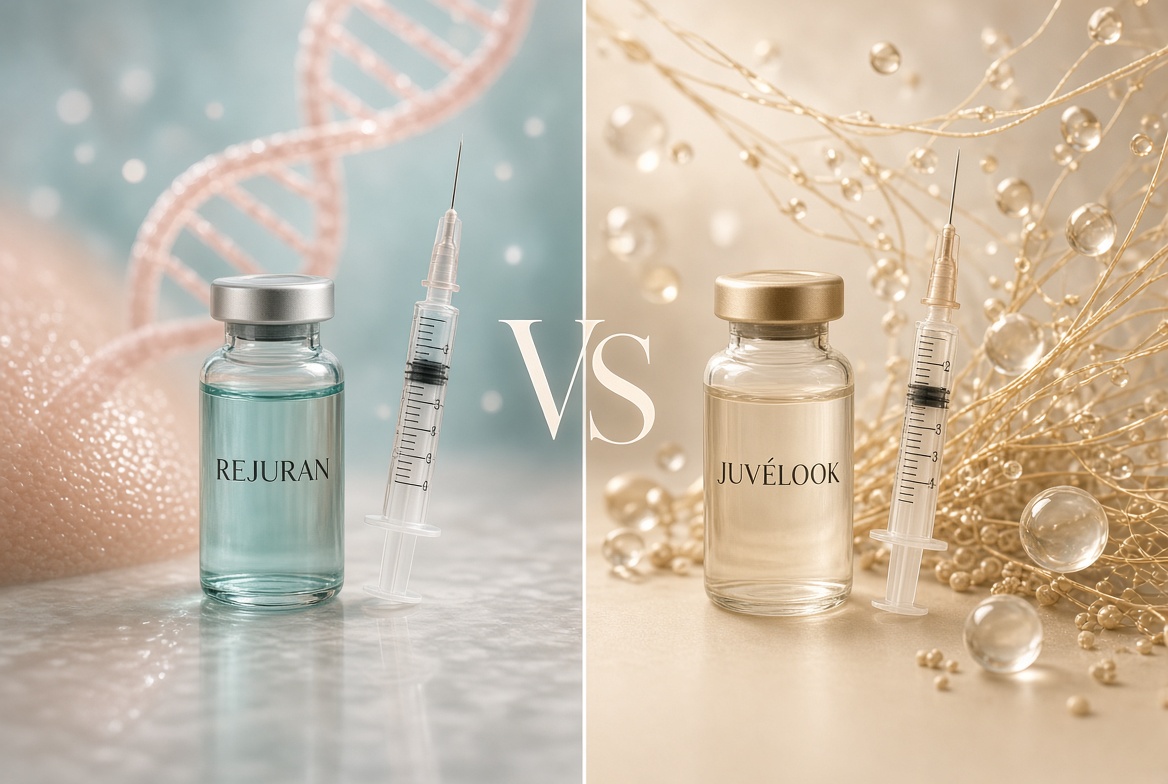
Rejuran and Juvelook are both popular Korean injectable skin boosters, but they work through different mechanisms and suit different concerns. Neither is universally “better”—the choice depends on whether your priority is repair/hydration/texture or collagen building/firmness.
Quick Comparison
| Feature | Rejuran (PN/PDRN) | Juvelook (PDLLA + HA) |
|---|---|---|
| Main active | Polynucleotides from salmon DNA | PDLLA microspheres + hyaluronic acid |
| How it works | Cellular repair, barrier support, healing, anti-inflammatory effects; improves skin quality from within | Biostimulator: HA for immediate hydration; PDLLA triggers new collagen production |
| Best for | Texture, dullness, pores, sensitive/thin/damaged skin, barrier issues, acne scars (especially healing/redness), under-eyes (dedicated versions), post-laser recovery | Firmness, fine lines, mild laxity/crepey skin, pores, shallow atrophic scars, overall density |
| Results onset | Gradual (visible around 3–4+ weeks) | Some immediate hydration from HA; collagen builds over 4–8+ weeks |
| Duration | Typically 6–12 months | Often 12–18+ months (up to ~24 in some reports) |
| Typical course | 3–4 sessions, 2–4 weeks apart | 2–3 sessions, several weeks apart |
| Immediate effect | Minimal | Yes (hydration) |
| Downtime | 1–3 days of small bumps (“mosquito bites”), redness; possible bruising | Similar (1–3 days bumps/redness); technique-sensitive |
Who Each Suits Best
Choose Rejuran if your skin is dull, dehydrated, thin, sensitive, reactive, or showing surface damage/texture issues (pores, uneven tone, post-acne healing). It excels at making skin calmer, more resilient, and healthier-looking without adding structural volume. There are variants like Rejuran Healer (standard), HB (with HA/lidocaine for less sting + hydration), and eye-specific formulas for thin under-eye skin.
Choose Juvelook if you want firmer skin, softer fine lines, better density, or improvement in shallow scars/pores via collagen. The HA gives an early glow, while the PDLLA (smaller, more uniform particles than classic PLLA like Sculptra) drives longer-term collagen. Juvelook Skin (smaller particles, more superficial) is preferred for texture/eyes; Juvelook Volume (larger particles) targets more structural support and is generally avoided in very thin areas.
Practical Notes
- Sessions & maintenance: Rejuran usually needs a fuller initial series with maintenance every ~6 months. Juvelook often requires fewer sessions with longer intervals between touch-ups.
- Pain & recovery: Both are done with numbing. Rejuran can sting more due to viscosity; Juvelook’s particles require careful dilution and even placement to minimize risk of temporary nodules (more technique-dependent than pure HA products).
- Safety: Both have generally favorable profiles when injected by experienced providers (common temporary redness, swelling, bumps, bruising). Rejuran requires caution with fish/salmon allergy. Juvelook (PDLLA) has a lower nodule risk than older PLLA products thanks to particle design, but improper technique or wrong variant in delicate areas (e.g., under eyes) can still cause issues. Not typically FDA-approved as facial injectables in the same way in the US; more widely used in Asia and other markets.
- Cost: Varies widely by clinic and location. In Seoul ranges, Rejuran is often lower per session than Juvelook.
Bottom line: Match the mechanism to the problem—repair and quality (Rejuran) versus rebuild and firmness (Juvelook). Many people benefit from both over time or in combination with lasers, microneedling, or other treatments. A proper in-person assessment by an experienced provider is essential, as skin type, age, exact concerns, and technique matter more than any general ranking.